Preston Corporation types
Contents
Overview
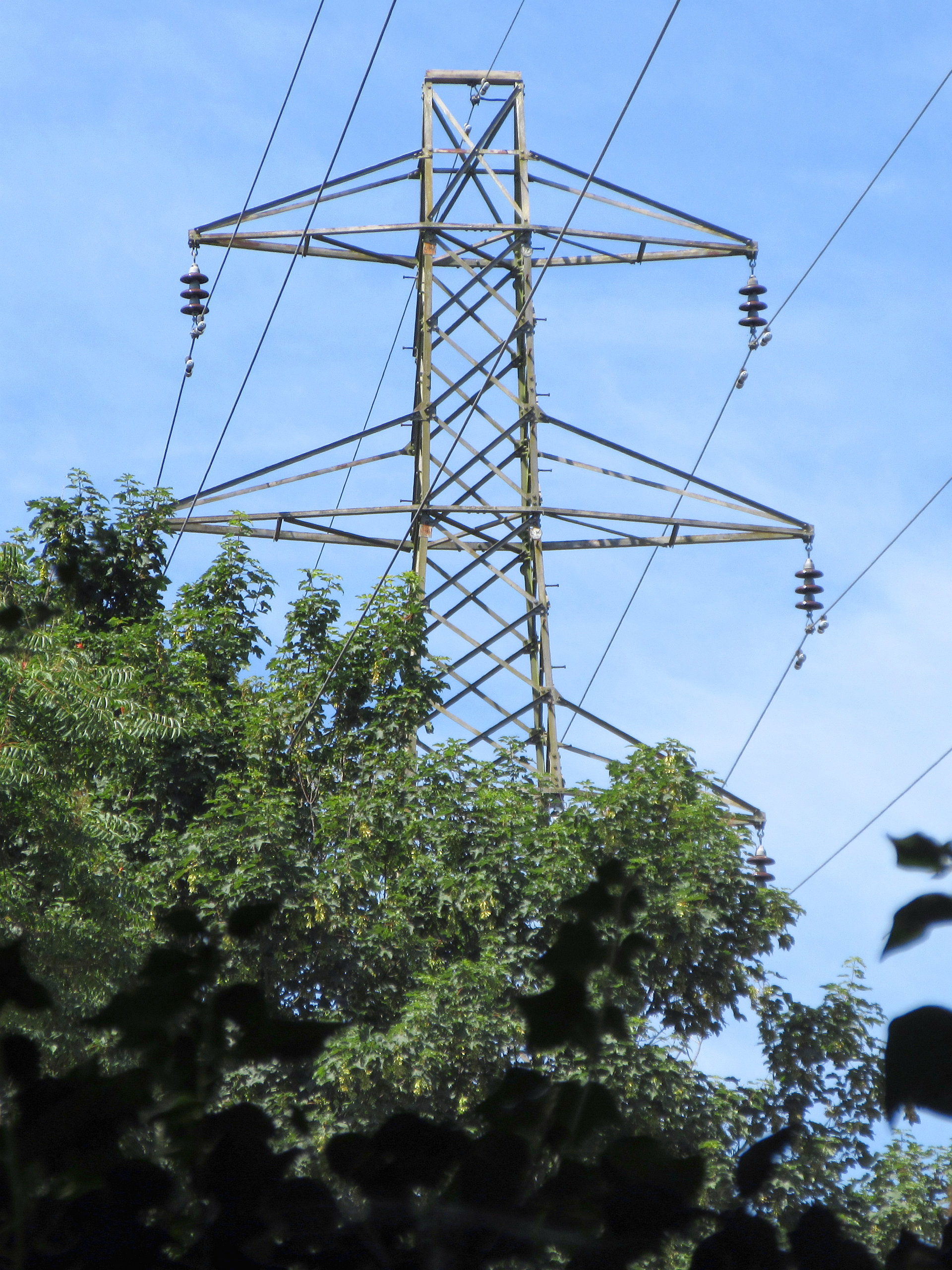
Two 66 kV (or 66/33 kV) power lines were constructed between Preston and Peel (outside Blackpool) using towers designed by Blaw Knox.
Two tower suites form the two original lines: Blaw Knox K5257 and K8790. Analysis of drawing number ranges places K5257 around 1940, and K8790 around 1945; the latter year is confirmed by Electricity North West. Application for planning consent was issued in 1946–1947, but this may have been retrospective as research by Tom Gloag suggests that numerous lines constructed after World War 2 had their planning applications filed retrospectively post-war.
Line RPA uses the D3 tower from K5257 and the D10 towers from both K5257 and K8790; the remainder of the towers appear to come from K8790. Most other lines use only the K8790 tower suite. K5257 appears to be an evolution of the design pattern used for SEE SL6, NWE SL4 and Coventry, with the D10 tower being of the suspension type; the Coventry and K8790 line towers are almost identical. K8970 has been dubbed “baby PL16” for having angle towers very similar to those used with SWE PL16, corresponding perhaps to being roughly contemporary with PL16.
Double earthwire was originally part of the design, but no longer exists. The RPB tower schedule still lists DD3, DD10 and DD30 types, but all towers are now single earthwire only.
General data
| Designed for | Preston Corporation |
|---|---|
| Design contractor | Blaw Knox, Milliken Brothers branch |
| Design contract |
K5257 K8790 |
| Height (straight line tower) | ? |
| Voltage | 66 kV |
| Dates back to | 1945 (K8790 drawings) |
| Known conductors | Single |
| Design conductor | 0.25□″ HDBC suggested (K8790) |
| Design earthwire | 0.1□″ HDBC suggested (K8790) |
| Circuit count | Double |
| Earthwire arrangement | Single, double |
Lines
Discovered lines to date, all 33 kV:
- RPA: Preston to Blackpool; K5257 D3, K5257 and K8790 D10 towers, all other towers K8790
- RPB: Preston to Blackpool, starting at Ribble GSP substation on a K9906 DT (tower RPB2A) and undergrounded at Staining Wood Farm solar plant outside Blackpool, with tap-off points including Clifton and Wrea Green (part of the route is on parallel wood poles); K8790 towers
- CT and CM, two short lines (12 and 5 towers respectively) in Middleton, originating near Whitegate substation in Middleton Junction, Greater Manchester; same line tower as RPB
- TA and TB, two short lines between Fleetwood and Thornton-Cleveleys; these are an odd mixture of K5257 and K8790, with K5257 D10 towers in suspension configuration
- Medway Grid–Halling–Luddesdown, from Medway Grid substation to a cable sealing end near Luddesdown (over a mile past Halling); same tower suite (RPB-type D3) except for a custom DT
A lone K8790 D3 tower used to exist on Darenth Wood Road in Dartford, Kent, but it has since been demolished.
At least part of the Medway Grid–Halling–Luddesdown line appears to be decommissioned, as the Luddesdown terminal tower is no longer connected.
A Google Street View survey of the various lines reveals the tower types used to include:
| Line | K5257 | K8790 | |||||||
|---|---|---|---|---|---|---|---|---|---|
| D3 | D10 | D30 | D3 | D10 | D30 | D60 | DT | DDT | |
| RPA (Preston to Blackpool) | ✓ | (✓) | (✓) | (✓) | ✓ | ✓ | ✓ | ✓ | |
| RPB (Preston to Blackpool) | ✓ | ✓ | ✓ | ✓ | ✓ | † | |||
| CM (Middleton) | ✓ | ✓ | |||||||
| CT (Middleton) | ✓ | ✓ | ✓ | ||||||
| TA (Fleetwood to Thornton-Cleveleys) | ✓ | ✓ | ✓ | ||||||
| TB (Fleetwood to Thornton-Cleveleys) | ✓ | ✓ | ✓ | ||||||
| Medway Grid to Luddesdown | ✓ | ✓ | |||||||
(✓) denotes non-standard towers. † denotes now-demolished towers.
Tower forms
Access to the drawings is forbidden, and as such, analysis of the towers is based on visual inspection from Google Street View in conjunction with the RPA and RPB tower schedules.
The diagrams below are all scaled to 8′–6″ crossarm spacing, as per Blaw Knox K9906, the 1945 Blaw Knox type shown in [Nicholls] and the SEE SL8 terminal gantry. This seems to fit in with the assumed 10′ height extensions and gives earthwire peak heights in (mostly) exactly whole number of feet (one came out as 6′–6″). The RPA tower schedule suggests that these figures are not monstrously off from reality.
The D3 towers are sufficiently narrow as to rely solely on X bracing without wider bracing panels, making guessing the standard heights of the towers tricky; the heights of these towers are an assumption based on the most frequent heights encountered.
The lines as they stand contain various oddities, as noted below.
No double earthwire towers are now known to exist. Both RPA and RPB began on DDT towers at Penwortham. RPB1 had an entry angle of around 45°. RPB2 then was a DD60, then RPB3 was a DD3, based on historic photographs. There is not a clear-enough view of RPB2 to be able to draw it, but very approximate attempts at RPB1 (DDT) and RPB3 (DD3) are included below. RPB1 is gone, and RPB2 is replaced with a K9906 DT (no. RPB2A). RPA85 and RPB75R have the vestigial peak of a DDT tower where the earthwire crossarm is meant to be attached, just as is the case with most PL16 DT towers (the DT was a later derivation from the DDT by omission of the earthwire crossarms).
All diagrams are scaled to 12 pixels per metre.
Blaw Knox K5257
K5257 appears to have had a suspension-type D10 tower; as per convention, these are now fitted with tension insulators. Towers TA4, TA5, TA6 and TB4 are the same D10 type, but with suspension insulators and in a straight-line alignment.
Towers RPA53 and RPA72 are anomalous in being the older “Evesque” design, and the tower schedule lists these as K5257 rather than K8790. The remainder of the angle towers are all K8790 “baby PL16” type.
K5257 appears to be around five feet taller than K8790.
Blaw Knox K8790
Tower RPB13 is noted as K8790 D60, but it is not the “baby PL16” type. However, it has the same tower body as the DT, and appears as such to be some kind of customisation.
RPB13 is listed as “D60E10”, although the tower design strongly suggests a D90. The base width of this alternative D60 should be the same as that of the DT and DDT, suggesting an error with the diagrams.
Uncertain
There appear to be broadly two designs of terminal tower. The type used for CM1, CT1 and TB5 carries integrated cable sealing ends and has the same tower body as the D60. The second type is designed for double earthwire (such as found at the Penwortham end of each line originally), and as RPB1 appears to have had around a 45° entry angle, this type could have been designated as either DDT or DDT45. DDT is more likely considering that 45° entry angle was inherent in the design of 132 kV terminal towers of that era (see CEB L132. The current designation used is “DT”.
A separate DT design is used in Kent, designed with an integrated sealing end platform.
Examples
Some pending.
Tower details
Insufficient data.
See also
- K8790 D3 (Geograph)
- Preston’s Power Stations (Flickr), including: (the photograph used for the basis of DD3 is not from this album and is of unknown origin)