Datanetics DC-60

Contents
- Overview
- Specifications
- Characteristics
- Models
- Keyboards
- Evolution
- Cherry M11
- Documentation
- See also
Overview
DC-60 is a family of tactile mechanical keyboard switches designed by Mike Muller of Datanetics and introduced in 1973, the same year in which they also introduced DC-50. In practice, all discovered examples to date appear to be the undocumented linear design. The most recent confirmed mention of DC-60 is US patent 5308943 filed in December 1992, where DC-61-41 is mentioned by name and depicted in the illustrations. Linear DC-60 switches were found in an American Dynamics AD1676BX manufactured in 1997, suggesting that DC-60 was still in production at this point.
The 1973 year of introduction is from Meryl Miller’s notes, although he also gave 1975 as the year of introduction. The switches are not believed to have been patented, and the oldest known mention of them discovered thus far is the 1975 brochure. Meryl noted that only momentary switches were available when the series was introduced; the alternate action design had been prototyped but not put into production. DC-60 alternate action switches were made available following ITT’s acquisition of Datanetics.
Meryl Miller suggests that the goals set for DC-60 were a low-profile form and a design that would lend itself to some amount of automated assembly. Shorter keycaps were also provided to reduce the keyboard profile even further. The lower profile compared to DC-60 gave the switch an advantage; with its lower cost, smaller size and support for plate mounting, DC-60 appears to have significantly outlived DC-50.
Specifications
The specifications differed between the 1975 brochure and the 1981 brochure, and between the latter and the 1985 advertisement in Electronic Engineers Master catalogue. Where the specifications changed, all values are given below.
The force ratings are all for the tactile type, as documentation of the linear type has never been found.
| Contact materials | Stainless steel with gold inlay |
|---|---|
| Preload | 1.4 oz (40 gf) |
| Operating force | 2.5 oz (71 gf) momentary |
| 3.5 oz (99 gf) alternate action | |
| Total travel force | 3 oz (85 gf) |
| Pretravel | 0.070±0.015″ (1.78±0.3 mm) |
| Total travel | 0.125±0.010″ (3.18±0.25 mm) |
| Contact resistance |
1 Ω max (100 mΩ typical) (1975, 1981) 150 mΩ max (1985) |
| Contact bounce |
2 ms max (0.5 ms typical) (1975) 5 ms max (0.5 ms typical) (1981) 0.5 ms max nominal (1985) |
| Rated lifetime |
Momentary: 10 M (1975) 15 M (1981) 20 M (1985) |
| Alternate action: 50,000 (1981) | |
| Current rating |
100 mA (1975, 1981) 50 mA switching (1985) |
| Voltage range |
0.5–300 V DC (1975, 1981) 30 V DC max (1985) |
| Volt–amp range | 5 to 200 mVA (1975, 1981) |
| Minimum spacing | 5⁄8″ (15.87 mm) |
Characteristics
DC-60 switches have the contacts in the centre and are thus single pole only. Momentary and alternate action is provided. The 1981 brochure indicates that LED illumination was possible, but such a switch has never been seen.
Profile
DC-60 switches were produced in three profiles: “low profile”, “lower profile” and “lowest profile”. The three profiles are illustrated below:
In the 1975 catalogue the product range covered “low profile” and “standard profile”, with distances from the PCB to the top of the plunger of 0.660″ (16.76 mm) and 0.775″ (19.69 mm) respectively. By 1981, these had been renamed to “lowest profile” and “lower profile” and were joined by a taller version now itself referred to as “low profile”, with a height of 0.831″ (21.10 mm). The 1981 catalogue incorrectly reports the lower-profile type to be 19.18 mm tall.
The three plunger styles can be seen in the photograph below:
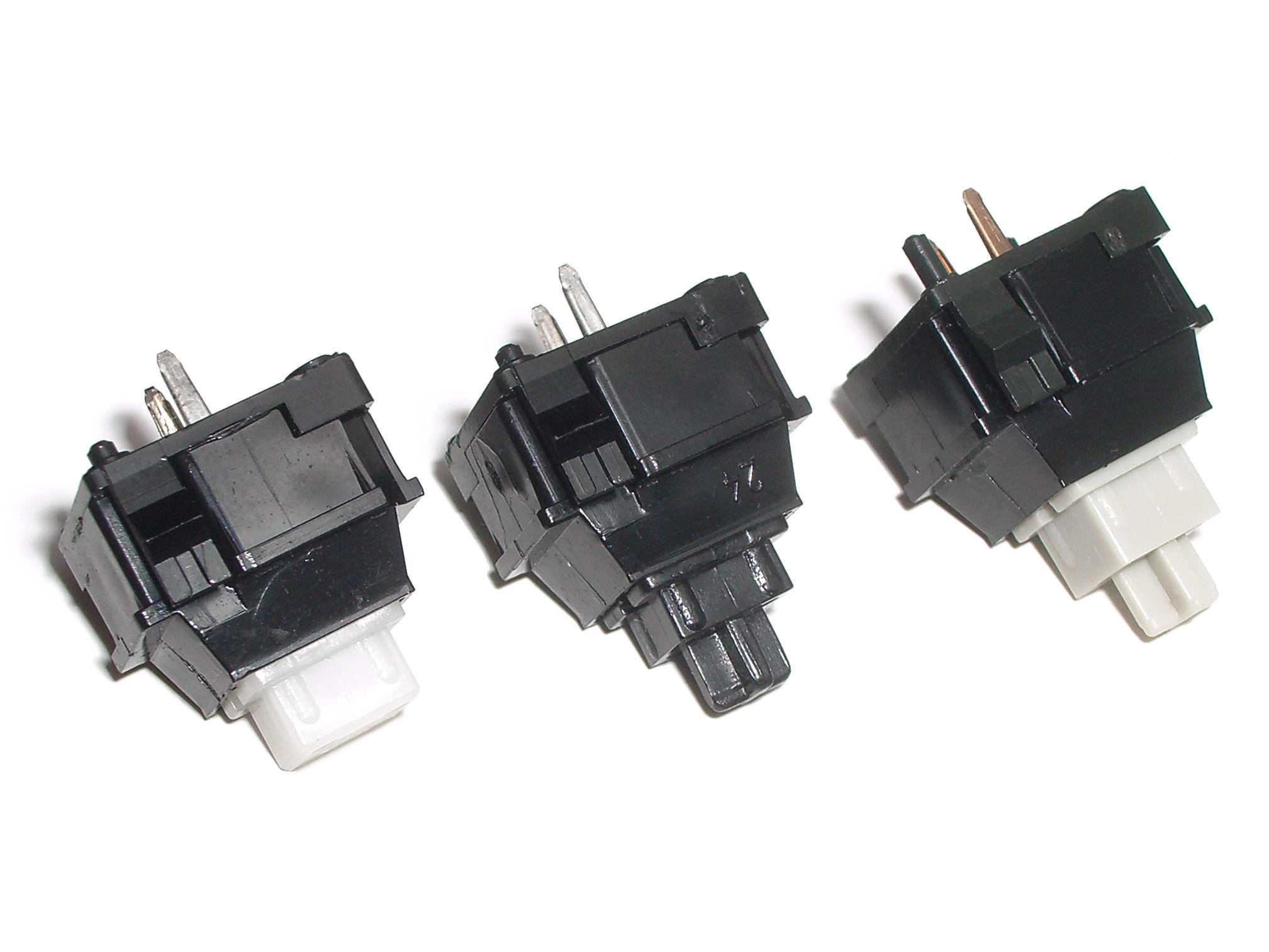
In ITT Schadow’s 1983 advertisement in Electronic Engineer Magazine (see under documentation below), the lowest-profile models (DC61-01 and DC61-02) are stated to be DIN-compliant, being “among the lowest profile module Key Switches ever built”, a claim that stands in stark contrast with Cherry M8 and RAFI RS 74 and 76 which are both distinctly smaller, with RS 74 being also almost a decade older.
Tactility
Official documentation for DC-60 indicates that these switches are tactile. The force curve is linear up to the tactile point, at which point a decrease in force of around 6.5 grams is shown. The perceived reduction in force feels like it is several times higher than the force curve depicts. Judging by a number of new old stock DC-61-05 switches from Australia, the tactile feel is somewhat inconsistent in strength and position between switches. The tactile point is generally strong, but more rounded than a click-leaf design. Arguably the tactile point is too stiff.
The force curve from the 1975 brochure is as follows:
The position of the pretravel line at 0.07″ is in the wrong place. The same graph was included in the 1981 catalogue without any corrections. Inspection of the internal parts would suggest that the contacts would close at possibly more like half way down the tactile drop.
In practice, most DC-60 switches discovered to date have been found to be linear. Sandy’s page on the Fluke Y1700 keyboard indicates that the switches are linear. Likewise, Jacob Alexander described the switches in that keyboard as “Fluke Linear Switch?” in his Fluke Y1700 Keyboard Flickr album. Switches resembling DC-61-02 sold in China are also linear.
The method by which the tactility is provided is not conclusively understood. Meryl Miller provided two assembled DC-60 switches: DC-61-03 (lower profile tactile) and a linear switch in lowest profile. An x-ray of both switches side by side seems to depict that they are structurally identical inside:

(The two switches were probably meant to face the same way, but the x-ray process ended up far harder than expected, with this being one final attempt at getting it right.)
Meryl also provided an unassembled DC-60 switch. Testing with these parts and those of a cut-open linear switch from China demonstrates that the contacts are responsible for the tactile feel. The step in the contacts is what provides downward force on the separator bar when the tactile point is reached. However, this step is still present even in linear switches. The most likely explanation appears to be that the level of tactility is set by the angle of the stepped contact at rest. Compare the following photograph, that shows tactile contacts on the left, and linear contacts on the right:

The switch on the left is Meryl’s tactile sample that was never assembled. The switch on the right is a lowest-profile linear type bought new old stock from China; this seems to be made on worn tooling.
In the linear design, the stepped contact is upright, while on the tactile version it is leaned to the left. It may be that in the linear version, the separator bar moves the straight contact, and in the tactile version the separator bar moves the stepped contact. Careful selection of the angles of the contacts should allow tuning of the tactile force. The x-ray likely shows the same appearance in both switches because a released switch will always hold each contact at the same angle; a second x-ray was needed that depicted each switch in the pressed position to capture how much each contact moved.
It should be possible to prove this from examination, but even after cutting away part of a plunger to get a clearer view of the contacts, it is still not possible to reliably observe how each one moves during switch operation.
Alternate action
The alternate action mechanism is very similar to that of DC-50. To accommodate the latching wire, there is a sloped cutaway on one side of the switch, and a small notch at the top. A small portion of the momentary linear switches purchased from AliExpress have the alternate action shell instead of the momentary shell.
The position of the alternate action wire at the top of the plunger means that the lowest-profile type was momentary earlier: it was not possible to fit a keycap if the alternate action wire was present.
Guide posts and standoffs
Officially DC-60 was offered in two types: with heat-stake guide posts, and with no guide posts. In reality, most discovered examples (including all of the samples that Meryl Miller preserved) instead have stand-offs, of the same design as the guide posts but significally smaller.
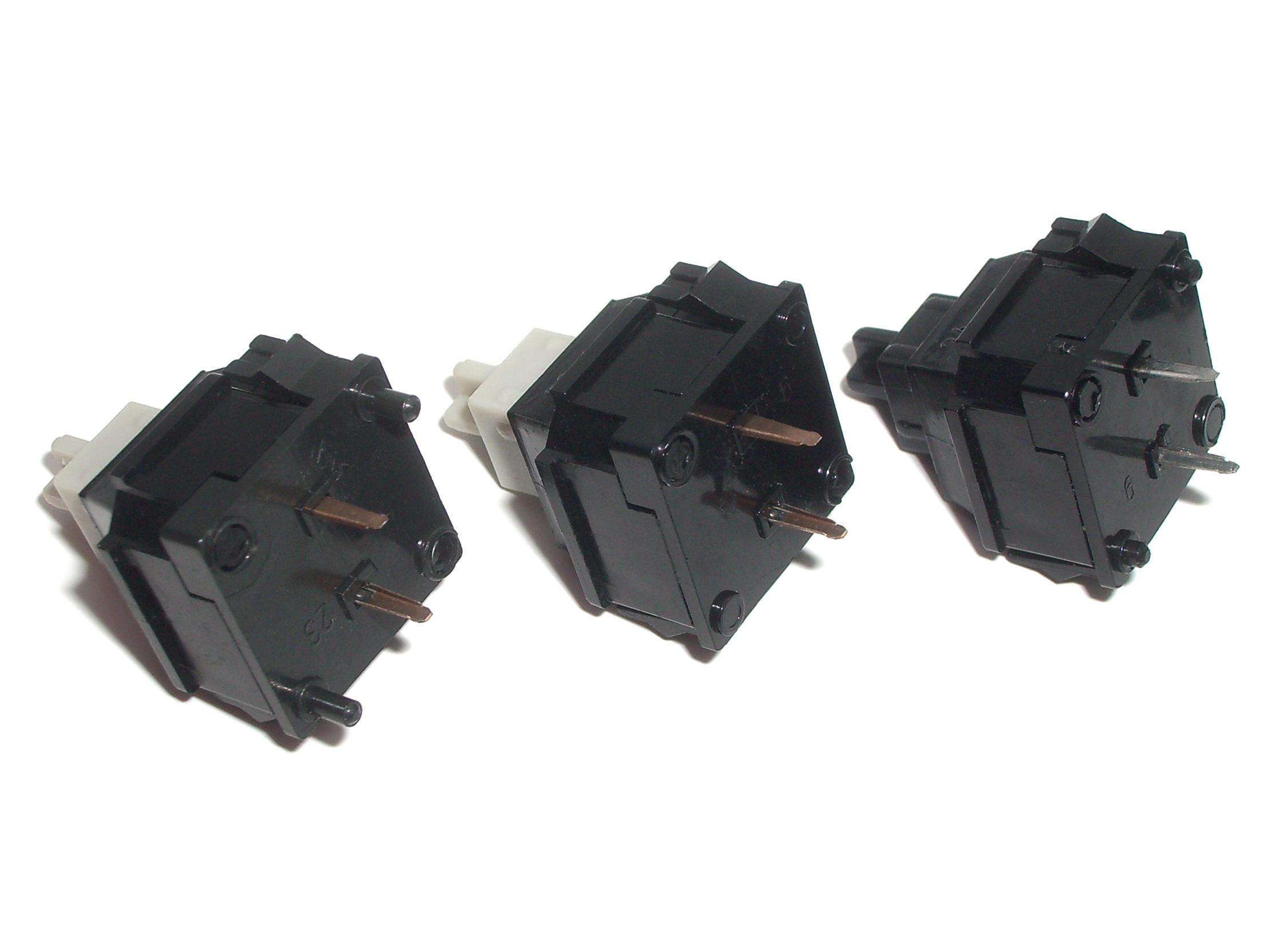
Meryl Miller noted, of the version with heat-stake posts, “I seem to recall that being a version that was made for a particular customer that wanted to heat stake and lock the switches into position prior to hand soldering the terminals.” However, there is no documented information now why the guide posts were reduced in size and what affect that had on the part numbers.
Models
Only a small number of model numbers (“dash” numbers in Datanetics terminology) are known. Only the standard models were listed in the brochures, and these types are all tactile. Although the majority of discovered examples appear to be linear, the existence of linear DC-60 is not something that Meryl Miller became aware of before he left Datanetics in 1979, although he did obtain a sample of a linear type. One extra model number is known from the Oxygen Electronics website, and they refuse to sell any. Another model number is known from US patent 5308943, where it is depicted inside a larger switch assembly.
It appears that the lowest profile plungers were colourless, the lower profile plungers were black and the low profile (tallest) plungers were a yellowish grey. HP however had brown plungers in their switches, made to the tallest profile. These can be seen in the HP 9825A.
Also listed for sale on AliExpress was a cream slider version with a smaller keystem that appears to be MX mount. terrycherry at Deskthority obtained some, but never reported on their characteristics.
| Model | Action | Profile | Guide posts | Source | Brochures | NSN |
|---|---|---|---|---|---|---|
| DC-61-01 | Momentary | Lowest | Present | Brochures | 1975, 1981 | |
| DC-61-02 | Momentary | Lowest | Absent | Brochures | 1975, 1981 | |
| DC-61-03 | Momentary | Lower | Present | Brochures | 1975, 1981 | 5930-01-213-0318 |
| DC-61-04 | Momentary | Lower | Absent | Brochures | 1975, 1981 | |
| DC-61-05 | Momentary | Low | Present | Brochures | 1981 | |
| DC-61-06 | Momentary | Low | Absent | Brochures | 1981 | 5930-01-135-4015 |
| DC-61-24 | Oxygen Electronics | |||||
| DC-61-41 | Momentary | Lowest | US patent 5308943 (1992) | |||
| DC-62-03 | Alternate | Lower | Present | Brochures | 1976, 1981 | 5930-01-212-7965 |
| DC-62-04 | Alternate | Lower | Absent | Brochures | 1976, 1981 | |
| DC-62-05 | Alternate | Low | Present | Brochures | 1976, 1981 | |
| DC-62-06 | Alternate | Low | Absent | Brochures | 1976, 1981 |
Different weightings have yet to be confirmed, but an example of two switches sharing a keycap suggests the use of half-force switches (the photos were shared by Deepak Kandepet, with no further information).
Keyboards
Keyboards and other equipment that uses DC-60 switches.
- Fluke Y1700 Keyboard (black, linear; 1983 copyright on PCB)
- Fluke 1720A Programmer Keyboard (black, linear, 1980 example)
- Fluke 5440B/AF front panel
- HP 9825A keyboard (brown, linear?)
- Unidentified HP keyboard; see under Cherry M11
- American Dynamics AD1676BX panel (black, linear; manufacture date 9745)
Evolution
The design of the housing (shell) changed a little with time:
The first design is from the brochure diagrams and is unattested.
The alternate action switch has a cutout in the shell to accommodate the latching arm, and some momentary switches were manufacturer with this shell.
Cherry M11
Sometime around 1979, it appears that Hewlett-Packard commissioned Cherry to produce a switch with the same dimensions as the tallest DC-60 type. This Cherry type is M11. As M11 is linear, the suggestion is that the DC-60 switches in HP keyboards were also linear.
Documentation
Meryl Miller provided three DC-60 brochures. These have been donated to the National Museum of American History Library (NMAHL) who provided higher quality scans. The remainder of the scans are from Bitsavers.
- DC-60 Series Low Profile Key Switches, December 1974 (from Meryl Miller; own scan; 600 DPI version)
- DC-60 Series Low Profile Key Switches, July 1975 (from Meryl Miller; NMAHL scan)
- TMI Come Up to Clads advertisement, EDN, August 1980 (scanned by Meryl Miller)
- DC-50/DC-60 Key Switches, ITT Datanetics, 1981 (from Meryl Miller; NMAHL scan)
- ITT Schadow advertisement, Electronic Engineers Master 1983–84 Volume 1 (includes DC50 and DC60)
- ITT Schadow advertisement, Electronic Engineers Master 1985–86 Volume B (includes DC 61)
- ITT Schadow advertisement, Electronic Engineers Master 1988–89 Volume B (includes DC 61)
- ITT Schadow advertisement, Electronic Engineers Master 1989–90 Volume B (includes DC 60)
Curiously, the December 1974 version of the DC-60 Series Low Profile Key Switches brochure includes DC-62 alternate action, whereas the July 1975 version omits them.
See also
- Datanetics DC-60 series (…) on the Deskthority wiki for prior notes and illustrations