Cherry MX
Contents
Overview
Cherry’s MX series is one of very few keyboard switch lines to have remained in production for decades, having been in continual production since their introduction in late 1983. Little else is still around from that age; RAFI’s switches from the 1970s are notable example. MX switches were produced in each of Cherry’s three switch factories: Auerbach in Germany, Waukegan in the United States, and at Hirose’s factory in Japan. US switch production ended in the late 80s, and Hirose discontinued MX in 2014, with MX switches now manufactured solely in Germany.
With such a long lifetime, the MX product range has incorporated a great deal of different features. As patented, the characteristics were:
- Tactile feedback
- Hysteresis (generated from the click-tactile mechanism)
- Double-pole contact arrangement
When advertised in the United States in September 1983 (and again in April 1984), the options were:
- LED illumination
- Double-pole
- Double contacts (confirmed by Günter Murmann as being the ability to fit each pole with redundant pairs of prisms, as partially depicted in the patent)
- Angled stems
The advertisement can be seen under Documentation below. The advertisement also lists “clean IC logic signals”, which MX designer Günter Murmann confirms is incorrect (and is quite simply impossible with a mechanical switch), and a lifetime of 50 million cycles, which he explains was a requirement of the typewriter industry. (Whether the switches were capable of that longevity then, is not clear, as the original rating was 20 million, later increased to 50 million.) Angled stems have yet to be seen, but Günter noted that the MX tooling was flexible, with the keystem being an insert in the plunger mould, to allow for a variety of keycap mounts to be readily accommodated.
Additional options in the product range available either from the start or from early in its lifetime were:
-
Support for any one of the following:
- LED (red, green or yellow)
- Diode
- Jumper
- Alternate action (discontinued)
- Higher weighting for space bar
- Tactile feedback without hysteresis (introduced around 1987, patented separately)
- Click feedback (introduced somewhere around 1988)
In recent years, the product range has gained a few new options targeted towards the modern market, especially gamers:
- Damping
- Reduced pretravel (for gamers)
- Transparent shell with lens for separate RGB LED (placed under the switch)
See the MX variants page for more details. See also the MX part number schema.
Additional customisations discovered include the following:
- Increased PCB-to-plate distance of 6 mm instead of 5 mm (“Cherry MX Olympia Linear Clear (…)”), supplied to AEG Olympia for typewriters
- Alps slot keycap mount (unknown customer and usage; Deskthority co-founder sixty reported that these were photographed in official Cherry cartons, but this photograph has been lost, and the person believed to have taken it does not respond to questions)
- NMB-like keycap mount (mistermed “Cherry MX Alps Clear (…)”), of unknown usage; this appears to be German-made
Cherry MX also has the dubious honour of being by far and above the most widely copied design on the market, with more Chinese copies now circulating than it is possible to keep track of. The same general design is even used on non-mechanical types, such as some modern photoelectric switches. Some of the clone types have introduced further innovations to the product design, including “box” stems to improve dust resistance, fully-enclosed contacts, click bars to improve the tactile feel and click sound (MX switches tend to develop a rattly click, that this resolves), better tactile force curves, and support for using all four base holes simultaneously for internal RGB LEDs (where Cherry opted to use SMD LEDs, as Matias did). All these improvements have been added to a 1983 design that has stood the test of time. Notably, MX switches are remarkably free of binding: they can be pressed off-angle and never get stuck, something that many rival designs including those from Alps and SMK never achieved reliably with their equivalent products.
MX Low Profile
In January 2018, Cherry announced MX Low Profile. Although the design of the switch was completely different to MX, for branding purposes Cherry chose to use the “MX” name for the new series, and it therefore shares the same part number schema as existing MX switches. MX Low Profile does still use a conventional plunger and accepts Cherry MX mount keycaps, so long as they are comparatively thin plastic and themselves low profile. MX Low Profile is covered on its own page, and is not discussed further here.
MX Ultra Low Profile
MX Ultra Low Profile deviates even further, being truly “MX” in name only. This is a laptop keyboard switch, with not just a different design, but also a force curve very different from any traditional MX model. MX Ultra Low Profile is likewise covered on its own page as it has no bearing on the history of MX switches proper.
History
Günter Murmann—the inventor of the MX switch—explains that the objective for creating Cherry MX was to meet DIN compliance. While they did already have a DIN-compliant switch available, Serie M8, it only provided 2.5 mm of travel, and MX provided a compact design that could nonetheless offer the full 4 mm travel. Hirose Cherry did extend M8 up to the full 4 mm of travel with MJ series, but they also adopted MX and operated their own MX production line.
The original MX design was of a linear switch. The hysteresis (“movement differential”) mechanism used in MX White and MX Blue was introduced at the behest of German typewriter manufacturer Olympia, although they never adopted the resulting product; see MX White on the MX variants page for a more detailed explanation. The resulting click sound was reduced to an acceptable level using lubrication, which was easy to accomplish by simply additing a lubrication station to the automated production line. At a later date, a variant was introduced without the lubrication such that the click sound would be unimpeded.
Although the movement differential mechanism also introduced tactile feedback, it was followed a few years later by a pure tactile design with no click sound and no hysteresis (“MX Clear”).
To meet reliability requirements, the movable contact leaf was designed to be bifurcated, with each side having its own contact prism, for a total of two pairs of prisms per pole. This design can be seen in the patent, although the patent illustrations show the contact leaf tines to be tied and fitted with a single central prism. However, the use of redundant contacts proved to be unnecessary.
The defined characteristics of MX from its patent (filed in 1982) are tactile feedback, hysteresis, and double-pole operation; the dual contact arrangement is mentioned in Cherry advertisements, but only partially depicted in the patent without any explanation.
It seems that MX was introduced over a year after the patent was filed. The following occurrences have been discovered to date (not counting more recent switch models):
| Date | Occurrence | Reference |
|---|---|---|
| 1982-08-06 | Date of patent application by Cherry Mikroschalter for MX White | German patent 3229465 |
| 1982-11-05 | Date of early (if not the original) MX part number schema (Nummern-System Tastenmodul) covering MX Black, Linear Grey, Lock, White and Click Grey (last revised 1983-09-07) | Cherry drawing TS 00006 |
| 1983-01-25 | Date of single-unit 8 mm keycap drawing (last revised 1987-10-21) | Cherry drawing 1P■11-NNNG3 (…) |
| 1983-07-12 | Filing date of US patent for MX White by Cherry Electrical Products in the US | US patent 4467160 |
| 1983-10 | Introduction of Cherry MX in Japan; according to the former Hirose Electric website, “Started sales of MX series, the Low Profile Key Switch.” | hirose-st.co.jp (Wayback Machine) |
| 1983-11-07 | Date that Cherry MX was introduced, according to a suspicious image from an unspecified brochure | Deskthority topic |
| 1985-07-28 | Handwritten date on a German datasheet listing MX Black, Linear Grey, White and Click Grey, but curiously not MX Lock | Cherry MX datasheet (…) |
| 1987-04-24 | Application date for MX Clear patent from Cherry Mikroschalter | German patent 3713775 |
| 1988-03-31 | Date of a revised MX part number schema which added MX Clear, Tactile Grey, Blue and Green (last revised 1988-08-10) | Cherry drawing TS 00006-2 (…) |
| 2009 | Hirose Cherry MX no longer advertised for sale | Correspondence with Hirose |
| 2014 | Hirose Cherry MX discontinued | Correspondence with Hirose |
Details of individual switches can be found under MX variants. See timeline page for entries covering all series.
Vintage MX
Within the keyboard enthusiast community there is a disputed notion of “vintage Cherry MX switches”. One forum post therein claims that unspecified “material testing” demonstrated that “cherry did change the material of their switches sometime in between 1994-95.” So-called “vintage” MX switches (in particular MX Black) are said to be smoother than modern MX switches. There is no dispute that some more recent keyboards (for example 2009-made Filco Majestouch with MX Brown and circa 2013 KBC Poker II with MX Red) have shipped with noticeably scratchy switches. Thus far, no confirmation has been obtained from Cherry or any former Cherry staff. The timeframe does seem to hint at cost reduction. Seemingly the only objective data available is force curve graphs in the Deskthority topic How Cherry has fallen from 2016 showing that “vintage” linear MX switches can be noticeably smoother than more recent production runs. Some of these problems seem to be down to injection mould lifetime rather than plastics, as suggested by the Geekhack topic.
Before any conclusion can be reached, more definitive data is needed.
Specifications
MX specifications have changed over time. Cherry MX was originally rated for a flat 20 million cycles, although the initial magazine advertisements in 1983 and 1984 claimed 50 million. Initially the alternate action type was either omitted or implied to be the same 20 million, but it is likely that they always had a 500 thousand cycle lifetime. The linear models were later officially uprated to 50 million cycles, and ergo tactile (“MX Brown”) was also given a 50 million lifetime. In a March 2020 blog post, CHERRY MX Update: more than 100 million actuations and a bounce time of less than one millisecond, Cherry announced that four models—MX Red, MX Black, MX Brown and MX Speed Silver—were now rated for 100 million cycles, although the Hexus article CHERRY MX Update: 100 million actuations dates back to January of the same year. Their own datasheets however only show this change for the RGB versions of those switches. Cherry also stated that they were able to reduce the bounce time from 5 ms to 1 ms, but this too is only reflected in the data for the RGB versions of the four aforementioned types, which may indicate that the datasheets contain old information.
The general specifications are summarised in the following table:
| Characteristic | Source | |||
|---|---|---|---|---|
| 1985 | 1994 | 2015–6 | 2020 | |
| Voltage | 5 V | 12 V AC/DC max, 2 V min | 12 V AC/DC max | |
| Current | 10 mA | 10 mA max AC/DC, 10 µA min DC | 10 mA max AC/DC | |
| Bounce time | 5 ms max. | 5 ms max. (actuation speed 0.4 ms−1) | ||
| Rated load | 5 V 1 mA | |||
| Rated life, linear | 20 million | 50 million | 100 million | |
| Rated life, click/hysteresis-tactile | 20 million | 50 million | ||
| Rated life, tactile | N/A | 20 million | ||
| Rated life, ergo tactile | N/A | 50 million | 100 million | |
| Rated life, alternate action | Not given | 500 thousand | Obsolete | |
| Rated life, damped linear | N/A | 50 million | ||
| Initial contact resistance | 200 mΩ (typical 25 mΩ) | Not given | ||
Specifications that are model-specific, such as operating force and travel, are given on the MX variants page.
The sources of data above are:
- 1985: Cherry Tastenmodul MX, annotated 28.07.85 (provided by Cherry)
- 1994: Cherry Keymodule MX, March 1994 (see Cherry catalogues (…) on the Deskthority wiki)
- 2015–6: datasheets on cherrymx.de
- 2020: datasheets on cherrymx.de
Production lines
Cherry had at least three separate production lines for MX. There is uncertainty about whether the first one was in Germany or Japan. What we do know, from Günter Murmann, is that the US production line for MX was opened following a highly successful introduction of MX. Some tooling was sent to the US factory, although the US design seemed to be a combination of both German and Japanese parts. The US-made types can be found in the rarely encountered KXN3 (enclosed) and BXN3 (unenclosed) lines of US-made MX keyboards, such as KXN3-8451 (…).
The movable switch contacts take two shapes, termed “A” and “M” for convenience: see under contacts for details. German MX switches are “M” style. Hirose-made MX switches are “A” style, as are US-made MX switches.
German-made switches used gold-plated wire contacts. These are the same as contact style 4 from M8 and M9 switches. This was a cost reduction over the solid prisms used in older switches, and M8 and M9 were both updated to offer this contact type. MX later switched back to solid prisms; according to Cherry, this was in either 2006 or 2007, a point in time that seems somewhat unlikely, as that would make the “MX-M8 adapter” switches far more recent than expected. Hirose used their own trapezoidal solid prism design in their M8 and MX switches.
US-made switches have the “A”-style movable contacts associated with Japanese-made switches, combined with the gold-plated wire contacts of the German-made switches. The movable contact metal has a mottled appearance, suggesting some kind of heat treatment. American MX production would have ended a few years later when Cherry’s US manufacturing closed down in the late 80s.
Each factory had its own marking scheme. German-made MX switches were colour coded, hence the colloquial names of “MX Black”, “MX Blue” etc. Hirose used coloured plungers as with Germany, but their pigments were very diluted, and their colour scheme remains unknown. US practice is also not entirely clear, as so few examples are known. Originally, the US factory marked space bar switches with red paint, just as they did M5 switches, with seemingly all switches having black plungers (which may explain the all-black MX Lock type). However, an unidentified KB-5000 keyboard made in the US with American MX switches has been found with a grey space bar switch; sadly the manufacture date is not known. It may be that the US factory did adopt the German colour scheme at some point. The “linear clear” switches found by cherry-jade and sold on Taobao appear to be US-made too.
The table below summarises the production lines:
| Factory | Movable contact | Crosspoint contacts |
|---|---|---|
| Cherry Electrical Products (US) | “A” style | Gold-plated wire |
| Cherry Mikroschalter (Germany) | “M” style | Gold-plated originally; now solid alloy prism |
| Hirose Cherry Precision (Japan) | “A” style | Hirose |
There is presently no evidence to suggest that Cherry made keyboard switches in the UK. Whether some of the rare types such as those with Alps mount came from Hirose or from another production line, remains unknown, as the origin of those types remains unconfirmed. Allegedly, Deskthority co-founder sixty observed one type in official Cherry packaging, but the photograph is since lost.
Design
The idea that the return spring descends into the central post, as seen in Lethal Squirrel’s animations, is a myth. The return spring is exactly the same width as the central post; the post only provides additional movement capacity for the slider.
Keycap mount
Cherry MX introduced the 8 mm mount. This is a keycap mount almost identical in cross-section dimensions to the 6 mm mount from M8 and M9, but the keystem is significantly taller:

The following illustration uses dimensions taken from official Cherry drawings. The keystem height is given in the Cherry MX brochure (see Cherry catalogues (…)). The keycap dimensions are taken from the Cherry MX developer page (Cherry previously supplied the official single-unit keycap drawing from 1983, but this new diagram on their website is clearer with regards the mount than the 1983 drawing). The stem dimensions are given in a drawing of the plunger posted within the Keychatter article Unpacking The Kailh Box Switch Debacle.

Now that the dimensions are known, it is possible to see that there is an 0.07 mm overlap on two of the four sides of the keystem where the keycap shaft is pushed outwards by the keystem. This is responsible for the grip. This is illustrated in the diagram below.

Switch contacts
There are two designs of movable contact, which UncleFan termed “A” and “M” based on the overall shape:
“M” style is the standard movable contact shape, and is found in most if not all German-made MX switches.
It always seemed that the “A” design was the original design, replaced soon afterwards by the “M” design. However, all Hirose-made switches examined to date (including all photos so far showing the insides of Hirose MX Orange) seem to be “A” style, including the NOS MX1A-0NNN parts stocked by Yamaha in Germany.
“A” style is currently associated with Hirose and tentatively with Cherry US. It is possible that Cherry Germany originally used this style. This is the style copied by Yali/Aristotle with Taiwan white and black shaft (…), and is found in the Teton Cherry MX clone (…).
Neither style is a match for the original patent, which depicts a distinctly different shape of movable contact.
Crosspoints
As noted earlier, the gold crosspoints differ in design depending on production line and age. The following diagram summarises the three types of contact crosspoints. The exact cross section of Hirose contacts varies from nearly trapezoidal to nearly semi-cylindrical, and possibly the movable contact prism is more trapezoid (they are not the same construction).
Cherry provided the following photos of MX wire and prism contacts in 2017 and 2016 respectively:
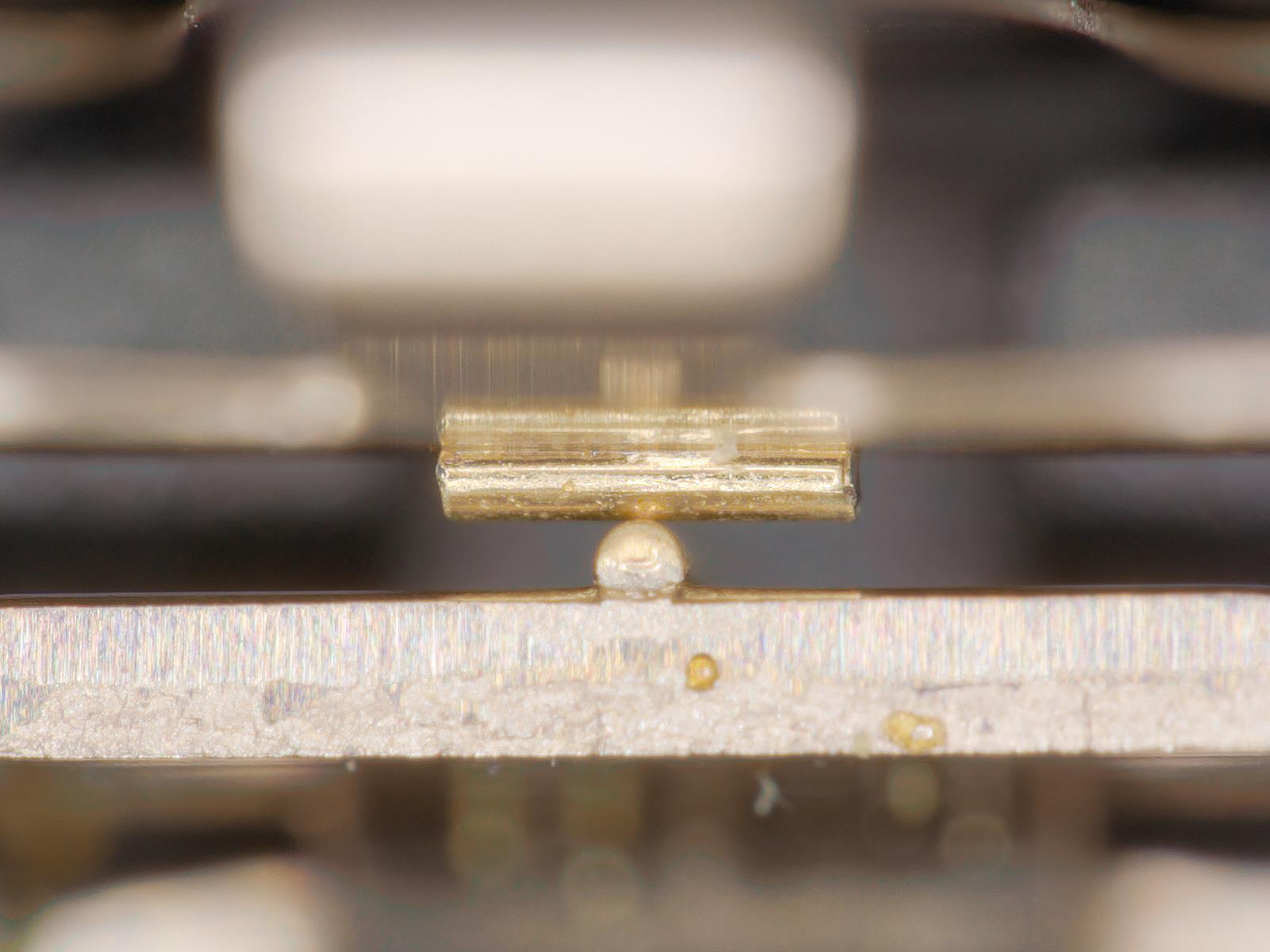

The images above are copyright cherrymx.de, used here with permission.
Shell
Cherry MX as patented was a non-illuminated design capable of double pole arrangement. The design that entered production changed to single-pole only, with a front-centre LED recess taking the place of the second pair of switch contacts. Two holes in the base of the switch accommodate the LED terminals. A second pair of holes in the bottom—placed either side of those for the LED—allowed the switch to contain a jumper (wire bridge) or a diode. Factory-fitted diodes, LEDs and jumpers were standard options. Only one of these options can be fitted to a single switch.
The shell came in two subtly different versions, depending on whether an LED was fitted in the factory. The MX1A-11GW page illustrates the differences between the two designs.
The rise in popularity of mechanical keyboards amongst gamers led to a need to support RGB LEDs, which have four terminals instead of two. Initially the clone market addressed this demand by retooling the shell to hold a larger LED, using all four holes at the front for the LED terminals. Cherry adopted a totally different approach, with a new shell that leaves space for an SMD LED. Above the LED is a lens formed as part of the transparent upper shell, which helps to spread the LED light out within the keycap to improve legend illumination.
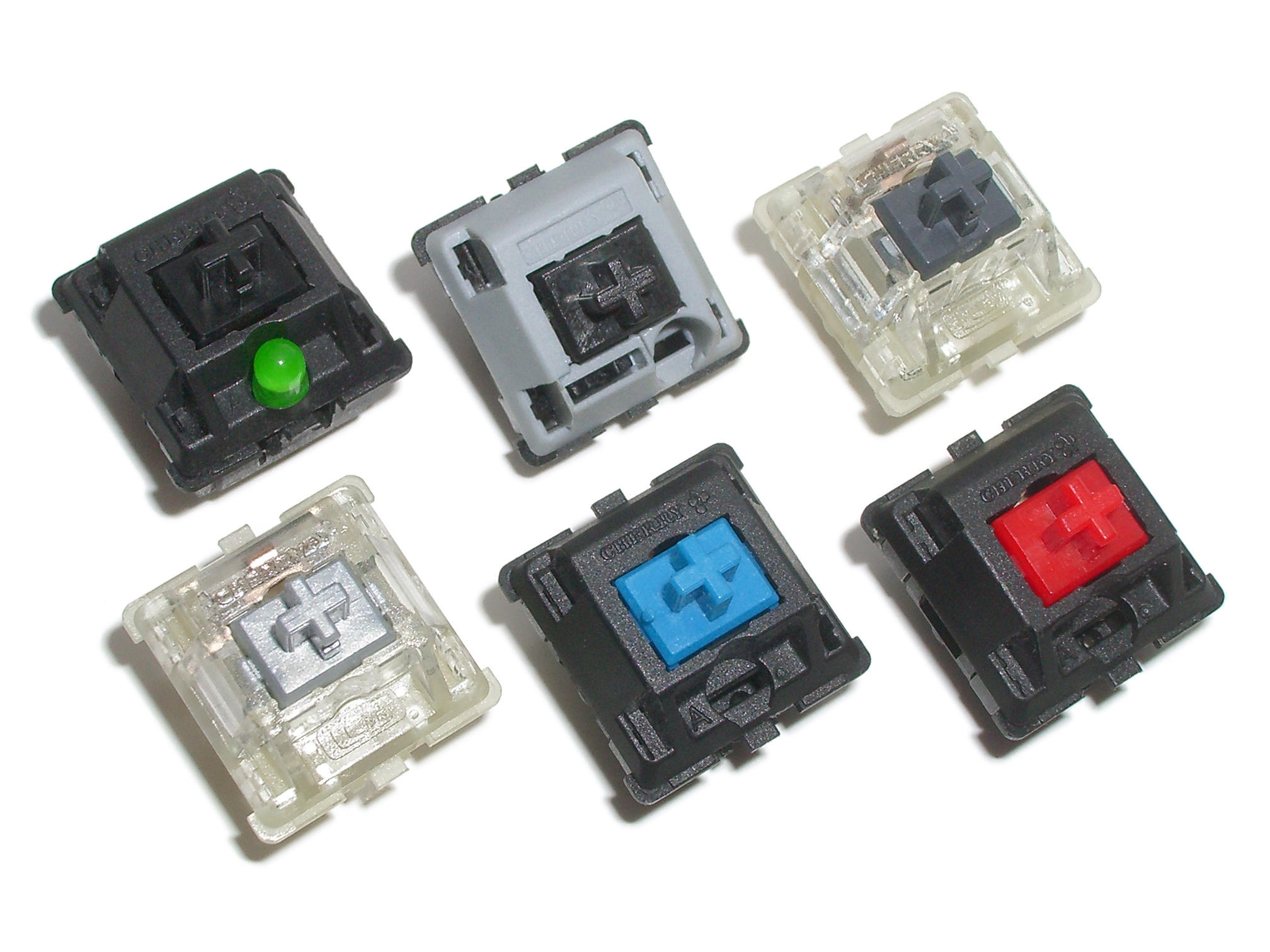
Colour and identification
Cherry have traditionally been fairly conservative with their plunger colours, both in the US and in Germany. The most common plunger colours were natural unpigmented (known as “clear”) and black. Günter Murmann indicated that this was a matter of cost: as standard colours for the raw plastic material, they were the cheapest options. Additional colours were used for customer-specific MX types so that they could be distinguished, in particular because MX was produced on high-volume automated machinery and it was important to be able to identify parts correctly.
Early MX switches appear to have used only natural, black and grey plastic for the plungers, with grey denoting space bar with MX instead of alternate action as it did with M6 and M7. The origin of the “cam” (or “nose” as it was known at Cherry Germany) for the models with movement differential is not known for certain, but the suggested explanation was that by adding a small hole to the mould, these switches could be identified by a visible protrusion without the need to purchase a separate plastic colour.
By 1988, the catalogue MX range had grown to include both click and non-click movement differential types, and additional colouration was adopted. The existence of unpigmented switches seemingly otherwise identical to MX Blue suggests that the blue colour was added later; currently there is no information available to confirm this.
Adaptation
Cherry MX has seen a considerable number of adaptations to suit customer requirements. As advertised in 1983, MX was said to offer “angled stems” and was depicted with a keystem potentially designed to accept the 6 mm keycaps designed for M8 switches. Although the angled stems have never been observed, nor the seemingly 6 mm plunger option, a number of variations are well known. These include:
- Extended plunger height
- Reduced above-plate height
- Alps-compatible keycap mount (although not formally confirmed to be genuine Cherry)
- An unrecognised keycap mount (also not formally confirmed to be genuine Cherry), incorrectly termed “Cherry MX Alps Clear (…)”
The two types with height alterations are likely to have been produced in order to allow MX to substitute for a different-sized switch without needing to redesign the typewriters in which they were to be used. “Cherry MX Olympia Linear Clear (…)” is an MX variant with a modified shell that makes the switch 1 mm shorter above the mounting plate, and consequently 1 mm deeper below the mounting plate. This type was likely intended to match the above-plate size of Marquardt Series 6180, to allow Olympia to change to MX switches without affecting the keycap height.
Another type, “Cherry MX-M8 Adapter (…)”, has a plunger that is extended in height by 1.5 mm. The informal moniker “MX-M8 Adapter” arises from the claim that these switches were designed to accept 6 mm M8 keycaps, but there is nothing about the switch that would suggest this. “MX-M8 Adapter” switches still have the standard keystem for 8 mm MX keycaps and the plunger height is simply extended. It seems more likely that this was done as a way to allow MX to supplant M9 in Triumph Adler typewriters. A TA SE 505 typewriter can be seen with both such switch types: black plunger and clear plunger. (The two types have specific purposes in the keyboard even though both seem to be identical internally.)
The most enigmatic adaptation is the “Nixie”, a special variant created for Nixdorf. No explanation has ever been found for why Cherry would create a variant with a translucent top shell.
Dr Click found a Cherry G80-1600HAD keyboard in which one of the LED switches has a screw inserted from below to prevent the plunger from moving. This may have been a customer alteration, as two other G80-1600HAD examples he found used a ca. 150 cN extra-stiff switch instead. In his experience, these lock-out screws are not found in G80-1600HAP, but he is aware of several G80-1600HAD keyboards that were found in China with lock-out screws. He is of the opinion that this is more likely to be a Cherry factory adaption than a customer alteration.
Documentation
- Cherry MX advertisement, Computer Design, September 1983, page 31 (scanned by Bitsavers)