Blaw Knox K1420

Contents
Overview
K1420 is a suite of single-circuit towers, possibly derived from PL16 gantries. The K1420 contract number was used for STL1-compliant designs for NoSHEB; the designation within England and Wales remains unknown. K1420 towers do not support an earthwire. K1420 uses a lighter 0.15□″ SCA conductor than more typical 132 kV towers (0.175□″ SCA). It appears that K1420 was designed for the line between Keith and Aberdeen.
K1420 primarily provides angle towers for 132 kV wood pole lines; such lines can be found in Scotland, Wales and England. This practice—wood pole intermediates with lattice angle towers—is also used extensively across Ireland for the single-circuit lines. Northern Ireland uses Blaw Knox K1641 lattice angle towers instead of K1420 for this purpose. The Republic of Ireland uses a curious design of angle tower where the centre conductor has to be routed around the tower body on pilot insulator sets.
The original K1420 line included a triangular formation line tower, that has been seldom used since.
Towers matching K1420 are occasionally used as gantries at PL16 junctions, such as one at Well End in Borehamwood, Hertfordshire, England; these may however be standard PL16 gantries. K1420 was also used along the Corrieyairack Pass in Scotland, where a double circuit STL1 (“PL16”) line split into two single circuit lines. This route has since been replaced by the Beauly–Denny line.
General data
| Designed for | North of Scotland Hydro-Electric Board (NoSHEB) |
|---|---|
| Designer | Blaw Knox, Milliken Brothers branch |
| Found |
|
| Height | 42′–6″ (13.0 m) (S10) |
| Voltage | 132 kV |
| Dates back to | 1947 (drawings) |
| Conductors | Single |
| Circuit count | Single |
| Design conductor | 0.15□″ SCA (150 mm² ACSR, most likely Wolf) |
| Normal span | Unknown |
| Drawing ranges | K1420 / XM2054 |
Lines
Lines confirmed so far:
-
All-K1420 lines:
- Kintore Grid Supply Point to Fiddes (routes XCW and CF). From Kintore to just south of the River Dee, using S2 lattice line towers; this will be part of the line from Keith to Aberdeen for which K1420 appears to have been designed. From this point onwards to Fiddes, various types of wood pole are used, with sections being an assortment of wood pole types and K1420 steel towers. Tower CF1 is a K1420 S10 at Fiddes. The change from XCW (from the Kintore end) to CF (from the Fiddes end) appears to be a junction south of Countesswells where the two lines meet across a double circuit line from Tarland to Airyhall.
- The spur to Nant power station, which tees off the line between Inveraray and Taynuilt north of Kilchrenan, starts out as K1420 before changing over to K1201
-
Wood pole intermediates with K1420 angle towers:
- Scotland:
- Fiddes to Brechin Grid (route FB)
- Brechin Grid to a junction with Tealing to Brechin (route TBN)
- Wales:
- Caernarfon–Pentir (route CY)
- Amlwch to near Wlyfa, Anglesey (route DD)
- Rhos Substation to Aberystwyth Substation (including the spur to Llanarth Substation)
- Rhos Substation to Rhydlydan Substation (including the spur to Lampeter Substation)
- Route 4ZC (Pentir–Trawsfynydd) carries 132 kV on the west circuit from Trawsfynydd up to Glan-Dwyfach (west of Garndolbenmaen), where the 132 kV circuit separates out on a wood pole line heading west to Y Ffor substation. (The west circuit from Glan-Dwyfach to Pentir is currently disconnected, but this is intended to change in the future.)
- England:
- Between Hayle and Rame substations in Cornwall. This line begins as double circuit before dividing into two single circuit lines: wood pole and K1420 to Rame, and Painter Brothers to Fraddon.
- Scotland:
Both of the respective terminal towers at Rhos Substation use K1420 ST terminal towers. Another ST is used at the tee for the spur to Lampeter Substation. At Rhydlydan Substation the line terminates on a K1420 ST; there is also an outbound line on “Trident” poles.
Tower forms
K1420 towers, shown to scale at 12 pixels per metre:
Example associated wood pole intermediates:
The dimensions of the wood poles are also not known; they are simply guesswork based on estimated ground clearance and similarity in size to K1420.
K1420 towers are quite small. The bottom crossarm of the S2 is around 46′–6″ from the ground compared to 56′–0″ for K1201 S2; for the angle towers the single crossarm is 40′–0″ from the ground versus 49′–3″ for the bottom crossarm of K1201.
Examples
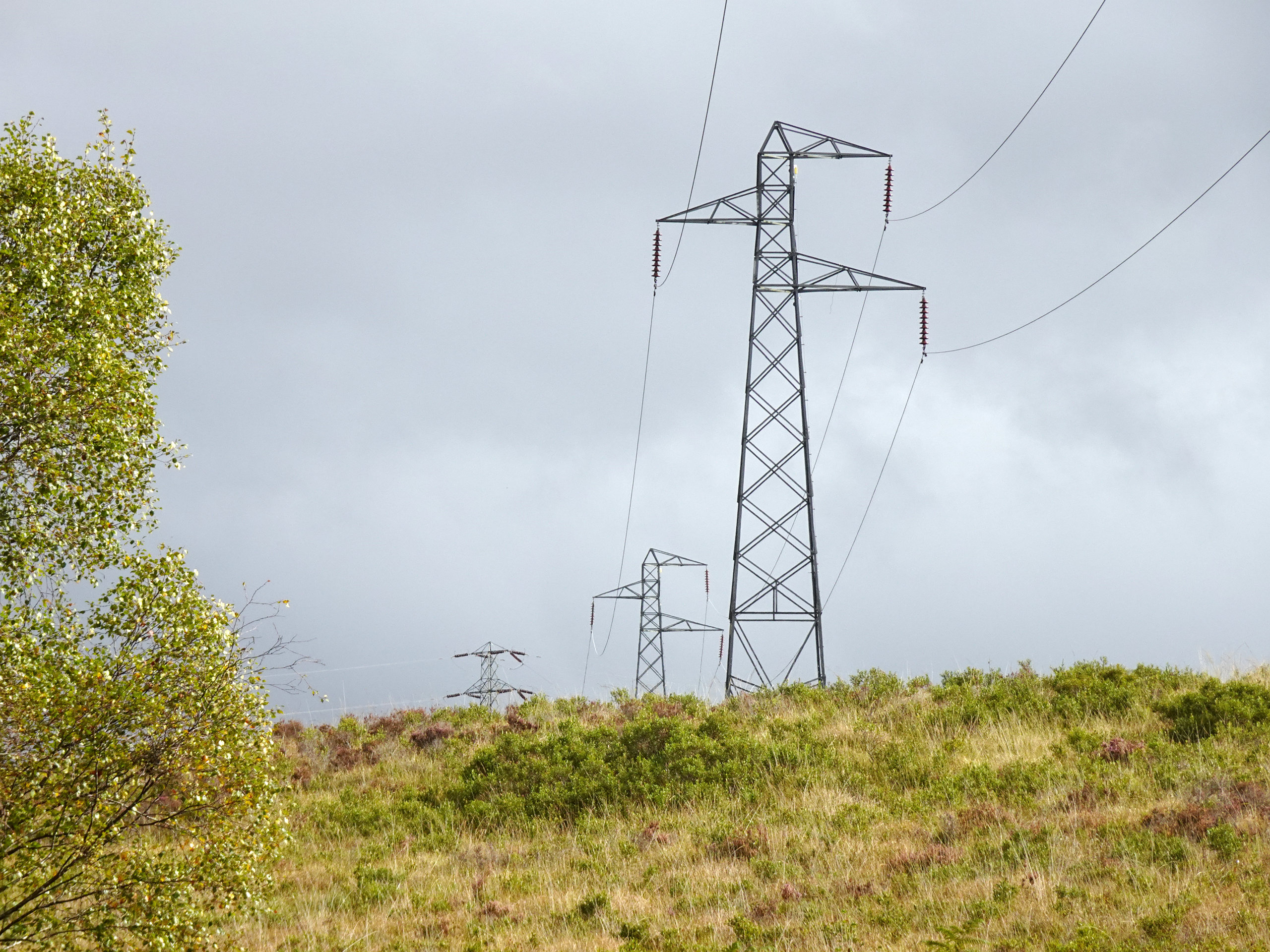
Tower details
See dimensions on the site guide page for a key to the tables. Crossarm width is the total width across the single crossarm.
| Type | Source | Height | Base width | Crossarm width |
|---|---|---|---|---|
| K1420 S2 | XM2054-1D, BK35/25414 | ca. 61′–6″ | 10′–0″ (3.0 m) | ca. 23′–9″ |
| K1420 S10 | XM2054-16A (35/4557) | 42′–6″ (13.0 m) | 11′–6″ (3.5 m) | 32′–0″ (9.8 m) |
| K1420 S30 | XM2054-14A (35/4559) | 42′–9″ (13.0 m) | 13′–0″ (4.0 m) | 33′–0″ (10.1 m) |
| K1420 S60 | K1420-20 | 42′–9″ (13.0 m) | 15′–6″ (4.7 m) | 35′–0″ (35.0 m) |
| K1420 ST | K1420-31 | 42′–9″ (13.0 m) | 15′–6″ (4.7 m) | 35′–0″ (35.0 m) |
| Type | Limits |
|---|---|
| K1420 ST | Entry angle 0–5° |
See also
- Corrieyairack Pass gantries, since removed (Flickr)
- K1420 ST used at a PL16 junction in what appears to be England (Flickr)
- K1420 ST, Rheidol, Wales (Alamy)